

When people think about Display Screen Equipment (DSE) risks, they often imagine obvious problems – a poor chair, someone working from a kitchen table or complaints of neck or back pain landing in HR’s inbox.
But while individual discomfort is usually what gets noticed first, the bigger issue often sits behind the scenes.
But DSE risk assessment systems rarely fail dramatically. Most of the time, they drift.
It happens slowly and quietly. Processes that worked perfectly when you had 20 staff can start feeling stretched at 50, 100 or 500. Small gaps appear, work patterns change, responsibilities become less clear, and before long the process you designed is no longer the process people are actually using.
The tricky part?
Everything can still look fine on the surface.
Assessments are happening. Equipment is being ordered. Boxes are being ticked.
But underneath, the system may be moving further away from what it was intended to do.
Here are five signs that your DSE risk assessment process might be quietly drifting.
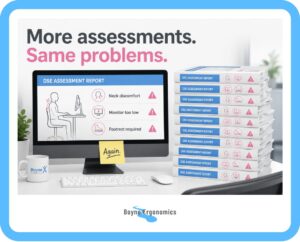
1. You’re doing more assessments… but seeing the same issues repeatedly
At first glance this can seem like a positive.
More assessments often means you’re being proactive and responding to needs.
But if the same recommendations keep appearing over and over again, it may be worth asking a bigger question:
Are we solving problems, or simply processing them?
For example:
- Repeated reports of neck discomfort
- Frequent monitor adjustments
- Recurring requests for footrests
- Similar posture issues across teams
Patterns usually tell a story.
If the same themes continue appearing, the issue may sit higher up the chain — equipment selection, onboarding processes, workstation standards, training or workstation design.
Doing more of the same doesn’t always create better outcomes.
Sometimes it simply creates more paperwork.
2. Nobody is fully sure who owns what
This one appears more often than people realise.
Ask a few different people:
“Who manages DSE?”
You might hear:
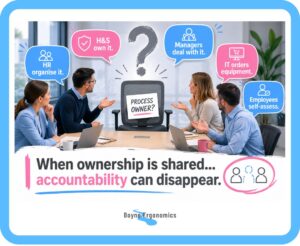
“HR organise assessments.”
“Health and Safety own it.”
“Managers deal with it.”
“IT order equipment.”
“Employees complete their own assessments.”
None of these answers are necessarily wrong.
The problem is when everyone owns part of the process, but nobody owns the process itself.
Because gaps tend to appear between responsibilities.
And gaps are where things quietly disappear.
3. New ways of working have arrived… but the risk assessment process stayed the same
Work has changed quickly.
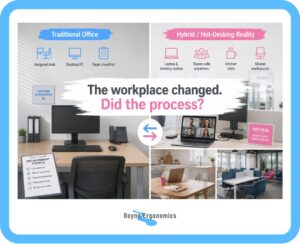
Hybrid working, remote working, hot-desking, flexible locations, shared workstations.
But many DSE risk assessment systems are still operating as if everyone has a permanent desk in one office.
Questions worth considering:
- How are workstation changes captured?
- What happens when someone moves location?
- What triggers a review?
- How are new starters managed?
If your risk assessment process was designed for a workplace that no longer exists, it may still be functioning — but not necessarily functioning well.
4. People only engage with DSE risk assessments when something goes wrong
For many organisations, DSE risk assessment becomes reactive.
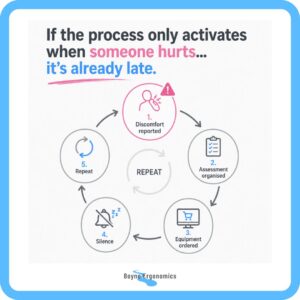
Someone reports discomfort.
An assessment gets organised.
Equipment gets ordered.
Then the process goes quiet again until the next issue appears.
The challenge with this approach is that it often means you’re relying on people reaching a point where they feel discomfort before action happens.
And not everyone reports issues straight away.
Some people adapt. Some ignore it. Some assume discomfort is simply “part of the job.”
A healthy DSE risk assessment process shouldn’t only wake up when there is a problem.
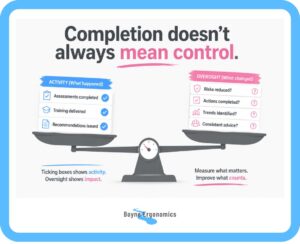
5. You’re measuring activity rather than oversight
This one is probably the easiest trap to fall into.
You know assessments are being completed.
You know training has happened.
You know recommendations were issued.
But do you know:
- Whether actions were completed?
- Whether risks reduced afterwards?
- Whether trends are emerging?
- Whether different assessors are giving consistent advice?
Activity tells you what happened.
Oversight tells you whether it’s working.
They’re not the same thing.
Small drifts become bigger gaps
The good news is that DSE drift isn’t usually caused by anyone doing something wrong.
Most organisations build processes around how work looked at the time.
The challenge is that work rarely stays still.
Small changes happen.
Teams grow.
Ways of working evolve.
Responsibilities shift.
Over time, even good risk assessment systems can slowly move away from where they started.
Sometimes the most useful question isn’t:
“Are we compliant?”
It’s:
“Is our DSE risk assessment process still designed for how we work today?”
Because a risk assessment process can still be active, still be compliant and still quietly be drifting.