

For many organisations, summer feels like a natural pause.
Annual leave is in full swing, offices are a little quieter, and the pace of business often eases just enough to catch your breath before September arrives.
It’s also one of the best opportunities of the year to improve workplace ergonomics.
By September, new starters are arriving, projects are ramping up, offices are busier, and employees are returning from holidays. Any small issues that have quietly developed over the previous months suddenly become much more noticeable. Minor discomfort becomes persistent pain. Temporary workarounds become permanent habits. Equipment requests increase. DSE assessments that were postponed become urgent.
It’s also worth remembering that this isn’t just good practice — it’s a legal requirement. Under the Safety, Health and Welfare at Work (General Application) Regulations 2007, employers must assess display screen equipment (DSE) workstations, provide appropriate training, and act on the findings. The Health and Safety Authority (HSA) expects this to be a genuine, ongoing process rather than a once-off form completed at induction.
The organisations that manage ergonomics most effectively rarely wait until problems appear.
Instead, they use quieter periods to review their systems, make practical improvements and ensure everything is ready before business accelerates again.
Here are five ergonomic checks worth completing before September gets busy.
1. Review Your DSE Assessment Process—Not Just Your Assessment Numbers
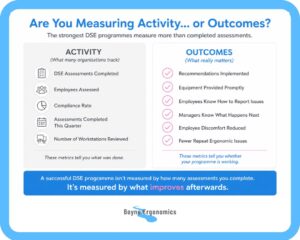
Many organisations are good at counting completed DSE assessments.
Fewer stop to ask whether the process itself is actually working.
A DSE assessment is only valuable if it leads to meaningful improvements. If recommendations aren’t implemented, equipment isn’t provided, or employees don’t know how to adjust their workstations, the assessment quickly becomes a paperwork exercise rather than a risk management tool.
Summer provides an ideal opportunity to step back and review your overall process.
Ask yourself:
-
- Are all DSE users being identified correctly?
-
- Are new starters assessed promptly?
-
- Are home workers included?
-
- Are reassessments taking place when required?
-
- Is there a clear process for employees to report discomfort?
-
- Are recommendations tracked through to completion?
-
- Is responsibility for actions clearly assigned?
It’s also worth reviewing how consistent your assessments are. If several different assessors complete DSE assessments across your organisation, are they all applying the same standards and providing similar recommendations?
Consistency builds confidence. Employees should receive the same quality of assessment regardless of who carries it out or where they work.
Rather than asking, “Have we completed enough assessments?”, consider asking:
“Is our DSE process actually preventing problems?“
That subtle shift in thinking often identifies opportunities for improvement that completion rates alone never reveal.
2. Walk Around Your Workplace With Fresh Eyes
One of the simplest but most effective ergonomic checks costs nothing.
Walk around your workplace. Not with a compliance checklist in your hand, but with genuine curiosity.
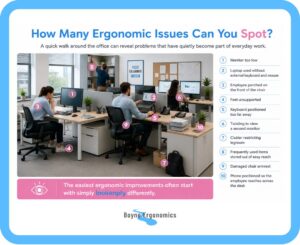
During busy periods it’s easy to become blind to issues that employees have simply adapted to.
You might notice:
-
- monitors positioned too low
-
- chairs with broken adjustment mechanisms
-
- employees perched on the edge of their chairs
-
- laptops being used without external keyboards or mice
-
- clutter reducing available workspace
-
- frequently used items stored outside comfortable reach
-
- damaged footrests or monitor risers
-
- temporary equipment that has quietly become permanent
Don’t just look at equipment. Watch how people actually work. Are they twisting repeatedly? Leaning forwards? Reaching unnecessarily? Standing for prolonged periods without variation? Small observations like these often reveal more than a completed checklist ever will.
If you operate hot-desking, this is also an excellent opportunity to test whether workstations can genuinely accommodate different users quickly and easily. Can employees adjust the chairs? Do monitor arms move freely? Are cables preventing adjustments? Is there clear guidance showing employees how to set up their workstation correctly?
A workstation may meet minimum requirements while still being difficult for employees to adjust effectively. Good ergonomics isn’t just about providing equipment. It’s about ensuring that equipment is easy to use in practice.
3. Check Whether Employees Know How to Adjust Their Workstations
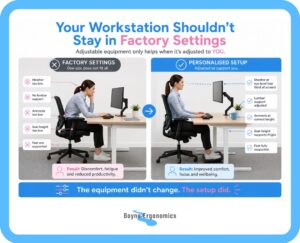
One of the biggest misconceptions in workplace ergonomics is that providing good equipment automatically solves ergonomic problems.
In reality, even excellent equipment can become ineffective if employees don’t know how to use it.
Many adjustable chairs remain in their factory settings for years.
Height-adjustable desks stay in one position.
Monitor arms are never moved.
Lumbar supports sit fully retracted.
Employees often tell me:
“I didn’t realise the chair did that.”
or
“Nobody ever showed me how to adjust it.”
This isn’t a criticism of employees.
It’s a reminder that good ergonomic outcomes depend on both equipment and education.
Summer is an excellent time to refresh workstation guidance across the organisation.
Simple reminders can make a significant difference.
Encourage employees to check:
-
- chair height
-
- backrest height
-
- lumbar support
-
- armrest position
-
- monitor height
-
- monitor distance
-
- keyboard and mouse position
-
- desk height
-
- foot support
Equally important is reinforcing that there is no single “correct” workstation setup for everyone.
People vary considerably in height, body proportions, mobility, medical history and personal preference.
The goal isn’t identical workstations.
It’s well-adjusted workstations that suit the individual. When employees understand how to make simple adjustments themselves, many small discomfort issues can be resolved before they require formal intervention.
4. Review Your Internal Ergonomics Capability
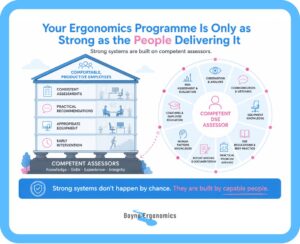
An effective DSE programme depends on more than good equipment.
It also depends on having people within the organisation who understand ergonomics well enough to identify problems and provide practical advice.
Many organisations have internal DSE assessors who completed training several years ago.
Since then, hybrid working has become widespread, home working has increased, height-adjustable desks have become more common, and organisations are supporting a broader range of employee needs than ever before.
Ask yourself:
-
- Are our assessors still confident?
-
- Have they received refresher training?
-
- Are they assessing hybrid work effectively?
-
- Do they understand current best practice?
-
- Are assessments being quality assured?
-
- Is there consistency between different assessors?
Internal assessors play an important role in supporting employees and helping organisations manage ergonomic risks proactively.
Supporting them with ongoing development helps maintain confidence and consistency across the entire DSE process.
Even experienced assessors benefit from regular opportunities to refresh their knowledge and discuss new challenges.
Investing in assessor competence isn’t just about compliance.
It’s about ensuring employees receive practical, consistent advice that genuinely improves how they work.
5. Plan Ahead for September
September has a habit of arriving all at once.
Employees return from annual leave.
Graduates and new starters begin.
Projects restart.
Office occupancy increases.
Equipment requests grow.
Managers become busier.
Unfortunately, ergonomic issues don’t wait patiently until everyone has more time.
Planning now can significantly reduce reactive work later.
Consider:
-
- scheduling workplace assessments in advance
-
- reviewing equipment budgets
-
- ordering replacement chairs before they are needed
-
- identifying high-risk work areas
-
- updating DSE guidance documents
-
- preparing induction material for new employees
-
- reviewing home-working arrangements
-
- confirming responsibilities within your DSE programme
If your organisation has been considering a wider ergonomic review, summer is often the least disruptive time to complete it.
By September you’ll already have a clear understanding of what needs attention rather than trying to assess issues while the organisation is operating at full capacity.

A Summer Investment That Pays Dividends
Summer presents something many organisations struggle to find during the rest of the year: breathing space.
Rather than waiting until September exposes the weaknesses in your ergonomic systems, use the quieter weeks to strengthen them now.
Review your DSE process.
Walk your workplace.
Refresh employee knowledge.
Support your internal assessors.
Plan ahead.
None of these steps require a major project, but together they can significantly improve employee comfort, reduce ergonomic risks and create a smoother return to full business activity after the summer.
By the time September arrives, you’ll be ready—not reacting.
Final Thoughts
The most successful organisations rarely see ergonomics as a one-off assessment or a compliance exercise.
They see it as an ongoing process of supporting people to work well.
Using the summer months to review that process is one of the simplest ways to stay ahead of potential issues before workloads increase and competing priorities return.
Sometimes the biggest improvements don’t come from buying new equipment.
They come from asking the right questions, making small practical changes, and ensuring your systems continue to support the people who rely on them every day.
If you’re unsure where to begin, start with one question:
If September was tomorrow, would we be confident that our workstations, our people and our processes are ready?
The answer to that question may tell you exactly where to start.