
If you asked most people where ergonomic risk lives in a business, they’d probably point to an office chair or a monitor that’s set at the wrong height. And they wouldn’t be wrong — but they’d only be telling part of the story.
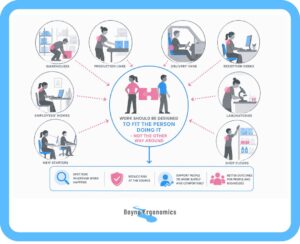
Ergonomic risk shows up wherever people do physical work: in warehouses, on production lines, in delivery vans, at reception desks, in laboratories, on shop floors, and increasingly, in employees’ spare rooms and kitchen tables. It shows up when someone reaches above shoulder height a hundred times a shift, when a load is stored below knee height, when a driver spends six hours a day in the same seated position, or when a new starter copies the desk setup of the person next to them without anyone checking if it actually suits them.
The common thread isn’t location. It’s this: work should be designed to fit the person doing it — not the other way around.
That idea sits behind everything I do at Boyne Ergonomics, and it’s worth unpacking a little, because it changes how organisations think about risk, training, and where to invest their time.
Training helps people move safely. It can’t fix a badly designed task
Manual handling training is essential, and nothing in this post is meant to undermine that. Good training genuinely helps people lift, carry and move things more safely.
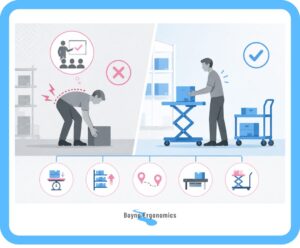
But training has limits. If someone is repeatedly lifting from floor level, working in a confined space, handling an awkward or unstable load, or repeating the same movement hundreds of times a day, the problem often isn’t how they’re lifting — it’s what they’re being asked to lift, where they’re lifting it from, or how often they’re doing it.
This is where ergonomics complements manual handling training rather than competing with it. Training changes the person’s technique. Ergonomics asks whether the task itself can be redesigned to reduce the physical demand in the first place — because health and safety best practice has always said the same thing: where reasonably practicable, reduce risk at its source, before relying on the individual to compensate for it.
In practice, that means asking a slightly different set of questions before reaching for a training course:
- Can the load be made lighter?
- Can it be stored at a better height?
- Can the handling distance be reduced?
- Can the workstation or process be redesigned?
- Can a mechanical aid do some of the work instead?
Manual handling training remains an important control measure. It should just rarely be the only one.
Your workplace data is already telling you something
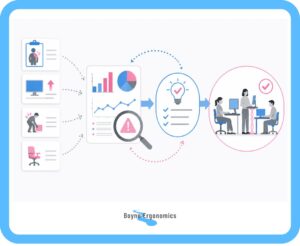
Most organisations collect far more information than they realise — DSE assessment recommendations, injury reports, equipment requests, return-to-work cases. Individually, each one looks like a one-off. Collectively, they’re often a pattern.
If three people in the same team report shoulder pain within six months, or several employees independently request a monitor riser, or the same department keeps experiencing manual handling injuries, those aren’t isolated incidents to close out one by one. They’re signals pointing to something structural — a workstation layout, a piece of equipment, a work process — that’s worth fixing once, properly, rather than repeatedly patching for each new person who runs into it.
This is a genuinely useful mindset shift for Health & Safety and HR teams: instead of asking “how do we resolve this individual case?”, it’s worth periodically stepping back and asking “what do all of these cases, together, tell us about the workplace?” Improving one workstation helps one person. Spotting and fixing the underlying pattern helps everyone who would otherwise have ended up with the same issue.
Ergonomics isn’t a corner of health and safety — it’s a way of designing work
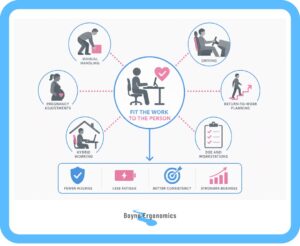
It’s easy to file ergonomics under “DSE assessments” and leave it there. But the same underlying principle — fit the work to the person — applies just as much to manual handling, driving, pregnancy-related adjustments, return-to-work planning, and hybrid working as it does to chair height.
When ergonomics is treated as one connected approach rather than a set of separate boxes to tick, two things tend to follow. First, problems get caught earlier, because the same lens is applied consistently rather than only when someone raises a formal issue. Second, the benefits extend beyond injury prevention — well-designed work tends to reduce fatigue, improve consistency, and make day-to-day tasks genuinely easier, which is good for people and good for the organisation.
Good ergonomics, in other words, isn’t a cost of doing business. It’s an investment in how the business actually gets the work done.
Where this leaves you
If you’re a Health & Safety manager, HR manager, or a decision-maker responsible for reducing risk across your organisation, the practical takeaway is simple: don’t stop at “have we trained people properly?” Ask “have we looked at the task itself, and are we spotting the patterns in the data we already have?”
That’s the conversation I have with organisations every day — helping them move from reacting to individual cases towards designing work that prevents the next one.
If you’d like to talk through where ergonomic risk might be sitting in your organisation, reach out — I’m always happy to have that conversation.