

Picture this.
I’m partway through a virtual DSE assessment. The person I’m working with is sitting in a basic height adjustable swivel chair, clearly not ticking every box on the compliance checklist. But they’re comfortable. Their posture is reasonable. They’ve been working from home for two years without a single complaint.
So what do I do with that?
It’s a situation I encounter regularly — and it gets to the heart of something that I think gets missed in a lot of DSE decision-making.
Compliance and Suitability Are Not the Same Thing
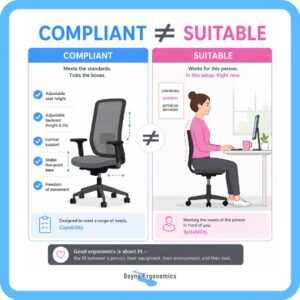
Most guidance, including under the Safety, Health and Welfare at Work (General Application) Regulations 2007, is clear on what a compliant office chair should include: adjustable seat height, adjustable backrest, adequate lumbar support, a stable five-point base, and freedom of movement.
On paper, it’s straightforward.
But here’s the thing. Those criteria exist for a reason — they describe the features that give a chair the potential to support a wide range of people across a wide range of body types, working patterns, and postures. They are, in essence, a checklist of capability. And that’s valuable. It sets a meaningful baseline and gives employers something concrete to work from.
What those criteria don’t do, however, is tell you whether the chair is actually working for the person sitting in it right now.
That’s the distinction that matters. Compliance is about whether equipment can be adjusted to meet a range of needs. Suitability is about whether it actually does meet the needs of the person in front of you. And in practice — especially in home working environments — those two things don’t always line up.
A chair can be fully compliant and still not be suitable for the person using it. I’ve seen highly adjustable, specification-meeting chairs that were set up incorrectly, never adjusted from the default position, and were quietly contributing to discomfort that the user had simply learned to live with. The chair ticked every box. The setup did not.
The reverse is equally true. A chair can fall short on technical criteria and still function well for an individual in their specific context. Someone of a particular build, working at a well-configured desk, for a manageable number of hours, in a role that involves regular movement away from the screen — that person and that chair might work perfectly well together, even if the chair wouldn’t pass a strict compliance review.
This is where a rules-based approach starts to show its limits. Regulations and guidance are written to apply across populations. They’re designed to protect the broadest possible range of people by setting standards that, if met, should work for most. But “most” is not “all” — and individual assessments are, by definition, about the individual in front of you.
The Danger of Treating Compliance as the End Point
When compliance becomes the goal rather than the starting point, something important gets lost.
Assessors and employers can fall into a pattern of asking “does this meet the standard?” and stopping there — either approving a setup because it looks right on paper, or flagging it for replacement because it doesn’t, without ever fully interrogating whether the equipment is genuinely causing a problem.
Both of those are errors. The first risks missing real issues hidden behind compliant-looking equipment. The second risks generating unnecessary cost and disruption in situations where no actual harm is occurring or likely to occur.
Good ergonomics has always been about fit — the fit between a person, their equipment, their environment, and their task. Compliance frameworks support that goal, but they can’t replace the judgment that comes from actually looking at how someone works. Are they shifting uncomfortably in their seat? Are they reaching, straining, or compensating in ways that might not be obvious in a short observation? Or are they settled, supported, and getting on with their work without difficulty?
Those observations matter more than whether the chair has a five-star base.
It’s also worth acknowledging that suitability isn’t static. A chair that works well for someone today may not work as well for them in six months if their role changes, their working hours increase, or they develop a health condition that affects their posture or comfort. This is why DSE assessment should never be a one-time event. Suitability needs to be revisited — not on a rigid annual schedule for its own sake, but whenever something meaningful changes for the individual.
When Non-Compliant Becomes a Problem
To be clear: not every non-compliant chair is acceptable.
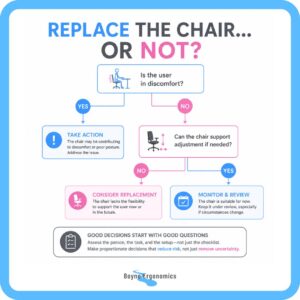
If a chair can’t be adjusted to support the user, is contributing to discomfort or fatigue, limits the ability to achieve a reasonable working posture, or is being used for prolonged periods without any flexibility — then it’s no longer just a compliance issue. It becomes a risk that needs to be addressed, and the decision is straightforward. The chair needs to change.
But that’s not the scenario I want to focus on here.
The Hidden Cost of Defaulting to “Just Replace It”
Where things get more complicated is when a chair is functional, currently suitable for the user, and not contributing to any discomfort. In those cases, the default response is often still: replace it.
It feels safe. It removes uncertainty. It ticks the box.
But it creates two very real costs that are easy to overlook.
The first is financial. Replacing chairs that are already working well — especially across a hybrid workforce — can accumulate quickly into unnecessary spend. Not because there’s a problem to solve, but because a checklist suggests there might be one.
The second is environmental. Replacing fully functional equipment contributes to avoidable waste, increased manufacturing demand, and shortened product lifecycles. For organisations with sustainability commitments, that’s a difficult position to justify — and one that rarely gets examined closely enough in DSE decision-making.
The Better Question
Rather than asking “is this chair compliant?”, the more useful question is:
“Is this chair suitable for this person, in this setup, over time — and is replacing it proportionate to the actual level of risk?”
In practice, that comes down to a few things. Is the user comfortable now? Can the chair be adjusted to support them if their needs change? Are there any early signs of discomfort or fatigue? How many hours a day is it being used? And is the setup likely to remain suitable as demands evolve?
If those answers raise concern, action is needed. If not, immediate replacement may not be the most proportionate response.
What This Means in Practice
A strong DSE process looks beyond the equipment itself. It considers how the equipment is being used, whether it’s genuinely supporting the individual, and whether it will continue to do so over time.
Sometimes the right decision is to replace the chair. Sometimes it’s to adjust, educate, and review. And sometimes, it’s to leave a perfectly good setup alone.
Compliance gives you a framework. Suitability tells you whether it’s working.
But here’s what I keep coming back to: a surprising number of DSE decisions are made to remove uncertainty rather than to reduce risk. And those aren’t always the same thing. When we default to replacing equipment that doesn’t need replacing, we’re not practising good ergonomics — we’re just managing our own discomfort with ambiguity.
That’s worth reflecting on.