

In my work, I support organisations on both a reactive and a proactive basis when it comes to managing DSE and wider ergonomic risk.
It’s important to be clear at the outset that DSE workstation risk assessments are a legal requirement under the Safety, Health and Welfare at Work (General Application) Regulations 2007, regardless of whether discomfort has been reported.
Work-related musculoskeletal discomfort can arise for a range of reasons. It may be linked to a specific injury, an underlying musculoskeletal or medical condition, or it may present as more general discomfort associated with how work is being carried out.
Whether there is a known, diagnosed issue or more general discomfort during work, one pattern I see consistently is this:
organisations with proactive DSE programmes tend to experience a lower demand for in-depth ergonomic risk assessments and specialist interventions over time, compared to those relying primarily on reactive responses.
That observation is what prompted this post.
For many organisations, DSE management starts out working just fine.
- DSE assessments completed sporadically.
- Someone reports discomfort.
- An assessment is arranged.
- Adjustments are made.
At low volume, this reactive approach feels manageable — even efficient.
But as organisations grow and become more complex, the cracks begin to show.
- Hybrid working becomes the norm.
- Roles diversify.
- Employees experience discomfort.
- Assessment requests increase.
- Expectations around consistency naturally rise.
Suddenly, a system that once felt perfectly adequate starts to strain.
Reactive DSE works — until it doesn’t
Let’s be clear: reactive DSE models aren’t inherently flawed. In fact, they’re often the most practical starting point for many organisations.
In my work with companies, I support reactive DSE assessments all the time — responding to specific employee concerns, addressing discomfort reports, and providing specialist input when issues arise. There is absolutely a place for this approach.
Reactive models tend to work well when:
- requests are infrequent
- teams are relatively small
- decision-making can be informal
- the same people are involved each time
In those conditions, issues can be addressed quickly and effectively.
Problems tend to emerge when demand increases — not because people stop caring, but because the underlying structure hasn’t evolved alongside the organisation’s needs.
What changes when volume increases
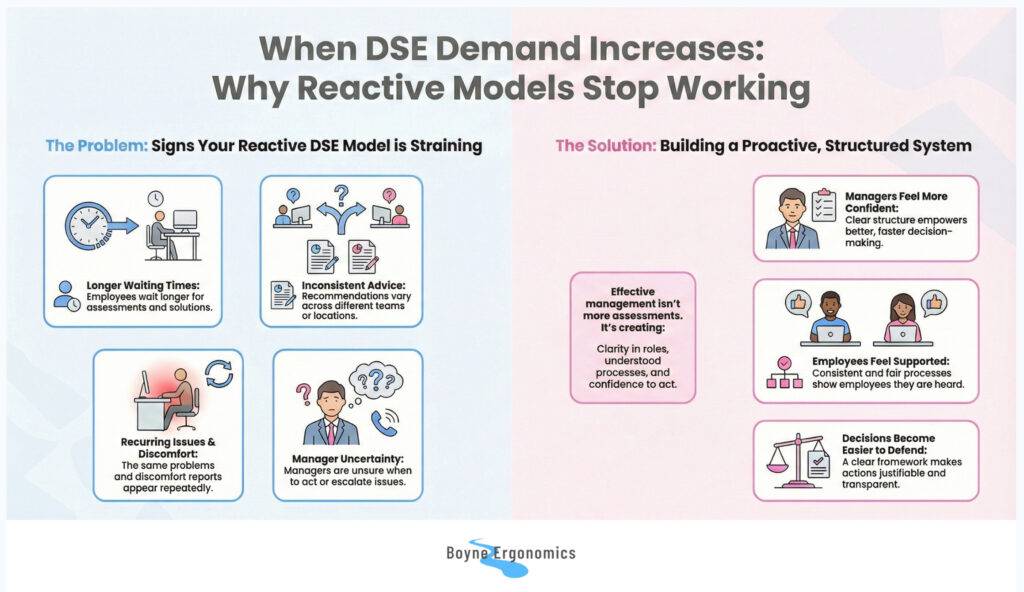
As DSE demand grows, organisations often begin to notice familiar patterns:
- longer waiting times for assessments
- inconsistent advice across teams or locations
- Increase in employees reporting discomfort or discomfort related absences
- the same issues appearing repeatedly in different parts of the business
- managers feeling uncertain about what they can resolve themselves versus what needs specialist input
These aren’t signs of poor intent or lack of effort.
They’re signs of a system being asked to do more than it was originally designed for.
At this stage, trying to do “more of the same, but faster” rarely solves the underlying problem. What’s usually needed is greater structure and clarity.
Why consistency becomes critical
As organisations scale, consistency starts to matter just as much as speed.
Employees reasonably expect:
- similar issues to be handled in similar ways
- clear explanations for decisions and recommendations
- confidence that advice is evidence-based and appropriate for their situation
Without a shared framework, decision-making can become fragmented — even when everyone involved is acting in good faith.
This often creates friction:
- employees wondering why recommendations differ
- managers uncertain about what’s reasonable to implement
- support teams under pressure to respond quickly while maintaining quality
The right structure reduces that friction significantly.
Moving toward proactive DSE management
This is where I see the value in working with organisations more proactively — not replacing reactive support, but complementing it.
Proactive DSE management isn’t a single action. It’s a shift in how capability and responsibility are distributed within the organisation.
It means building internal capability so that:
- routine assessments can be handled internally with confidence
- issues are identified and addressed earlier
- specialist input is reserved for genuinely complex cases
- consistency improves across locations and teams
When I work proactively with organisations, the focus is typically on developing internal capability through training and clear frameworks. This doesn’t eliminate the need for reactive support — it makes reactive interventions more targeted and effective.
Building internal capability as demand grows
One effective response to increased DSE demand is developing internal capability.
This doesn’t mean replacing specialist ergonomic support.
It means using it more strategically.
Organisations that invest in internal DSE capability often see benefits such as:
- faster initial responses to employee concerns
- more consistent decision-making across the organisation
- earlier identification of potential issues
- clearer escalation pathways when specialist input is genuinely needed
Trained internal assessors handle routine reviews and early-stage concerns. More complex cases are escalated appropriately.
The result is a system that scales more smoothly, without overloading any single part of it — and without being dependent on external availability for every assessment request.
Structure reduces pressure — for everyone
Effective DSE management at scale isn’t about conducting more assessments.
It’s about creating:
- clarity around roles and responsibilities
- agreed processes that people actually understand
- confidence in knowing when to act and when to escalate
When structure improves, pressure reduces across the board:
- managers feel more confident in their decision-making
- employees feel better supported and heard
- decisions become easier to justify and defend
Perhaps most importantly, early warning signals are more likely to be addressed before they develop into persistent problems.
Blending reactive and proactive approaches
In practice, most organisations benefit from a blended model.
Reactive support addresses immediate needs — specific concerns, complex cases, or situations requiring specialist assessment.
Proactive capability-building provides the foundation — trained assessors, clear processes, and consistent frameworks.
Both approaches have value. The key question is whether the balance reflects where the organisation is now.
Finding your proportionate next step
Not every organisation needs the same DSE model — and that’s perfectly appropriate.
But when demand increases, it’s worth stepping back and asking:
- does our current approach still fit the level of complexity we’re managing?
- are we relying too heavily on ad-hoc, case-by-case responses?
- would clearer structure improve both consistency and confidence?
- could developing internal capability or agreeing a regular, structured assessment schedule with an external assessor reduce pressure while improving outcomes?
These are governance questions, not admissions of failure.
They’re a natural part of organisations maturing in how they manage workplace risk.
Final thought
Reactive DSE models work well — until volume, complexity, and expectations shift.
When that happens, the solution isn’t simply moving faster or doing more reactive assessments. It’s building better structure through proactive capability development.
Both reactive and proactive approaches have a role. The most effective DSE management typically blends them — using each where it works best.
Thoughtful structure doesn’t add complexity.
It makes everything else easier to manage.