

Why effective ergonomic solutions start with understanding the person, the task and the working day.
An employee reports discomfort. The conversation quickly turns to equipment.
Would a new chair help? Should they have a sit–stand desk? Is there a better mouse?
These are reasonable questions. Appropriate equipment can make a meaningful difference. But before choosing a product, there is another question worth asking:
What is this job actually asking of the person doing it?
The answer helps establish whether equipment is needed, what it needs to do, and which other changes may be necessary. It can also prevent a well-intentioned purchase from leaving the underlying difficulty unresolved.
Look at the person and the work together
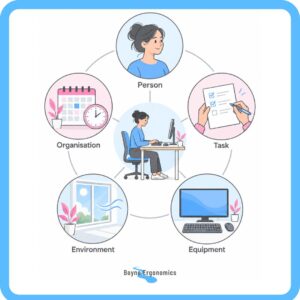
An ergonomic assessment considers five connected elements: the person, the task, the equipment, the environment and the organisation.
The person brings their own stature, capabilities, experience and needs. The task determines the movements, forces, attention and time involved. Equipment and layout influence how the task can be performed. The environment may introduce constraints such as limited space, glare or draughts. Work organisation shapes the pace, duration, variety and opportunities for recovery.
Looking at these elements together gives an equipment recommendation its purpose. A compact keyboard, for example, may be useful because it allows the mouse to sit closer to the employee. Its value depends on the person’s tasks, their use of a numeric keypad and how the workstation is arranged.
An “ergonomic” label is no substitute for checking suitability.
One equipment request can reveal several issues
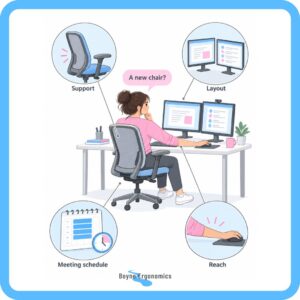
Consider an illustrative office example. An employee asks for a new chair because they experience discomfort during computer work.
An assessment identifies that the chair does not provide suitable support. It also finds that the mouse is positioned too far away, the screen layout encourages repeated turning, and consecutive virtual meetings leave few opportunities to move.
A more suitable chair may be part of the solution. Bringing the mouse closer and changing the screen layout address different demands. Reviewing meeting arrangements may create opportunities to change position and activity.
Each adjustment has a reason. The follow-up question is whether the combination improves the employee’s experience of doing the work.
This example is illustrative, rather than a report of a specific client case. It shows why understanding the working day matters alongside checking the workstation.
The same principle applies beyond the desk
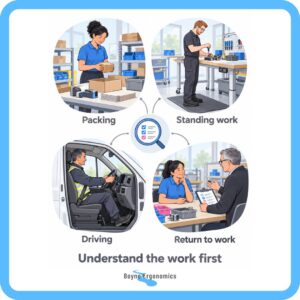
In production or packing work, a task may involve light items but repeated reaching, gripping or wrist movements. The assessment needs to consider frequency, duration, force, posture and recovery opportunities. A change to bench height may help, while the position of materials or the way work is allocated may also need attention.
A standing workstation deserves the same scrutiny. Can the employee change position? Does the working height suit both the person and the task? Are frequently used items within a suitable reach? Moving work to a standing bench does not, by itself, establish that the setup is appropriate.
For employees who drive for work, the seat is one part of the picture. Pedal and control reach, clearance, visibility, time spent driving, and entry and exit demands all warrant consideration. A vehicle can offer adjustments while still having an adjustment range that does not adequately suit a particular driver.
In return-to-work cases, a diagnosis provides relevant context, but cannot determine an equipment list on its own. The assessment needs to understand how the individual is affected, the demands of their actual role and any relevant occupational health or treating specialist advice. Equipment, task arrangements and a review as needs change may all form part of the response.
Across these settings, the starting point is the same: understand the work before selecting the intervention.
Good advice needs a working day that makes it possible
EU-OSHA’s 2026–2028 Healthy Workplaces Campaign, “Together for mental health at work”, launches on 13 October 2026. The campaign focuses on preventing psychosocial risks and supporting mentally healthy workplaces.
For employers reviewing ergonomics, it provides a timely reason to consider how work is designed and organised.
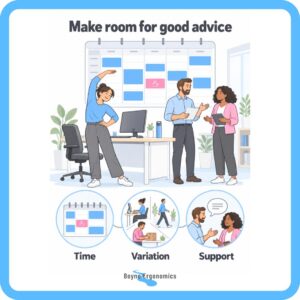
An employee may know they should change activity regularly, but have a diary filled with consecutive calls. A packing worker may be encouraged to vary their posture, while the layout and pace of work leave little room to do so. Someone returning to work may have suitable equipment, while their task demands still need review.
These situations prompt useful questions about workload, control over work and the support available to make adjustments practical.
EU-OSHA’s musculoskeletal disorder guidance also supports a combined approach that considers workplace ergonomics, work organisation and psychosocial factors. That is a useful connection between the campaign and everyday ergonomic decision-making.
An ergonomic assessment can contribute to this understanding. A wider assessment of psychosocial risks may also be needed, depending on the issues identified.
For employers, the practical question is simple: can people actually use the advice within the work they are expected to do?
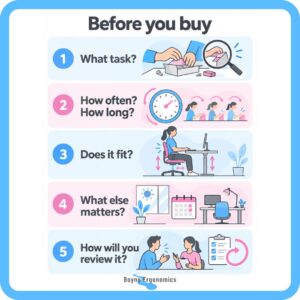
Five questions to ask before buying equipment
1. What task causes the difficulty?
Ask when it occurs and what the employee is doing at the time. Observe the relevant activity where possible. A general report of discomfort is a starting point for investigation.
2. How often and for how long?
Consider repetition, sustained postures, force and opportunities to recover or change activity. The demands of an occasional task can differ considerably from those of a task repeated throughout a shift.
3. Does the setup fit the individual?
Check reach, clearance, support and adjustment ranges. Consider whether the proposed equipment works with the existing desk, bench, vehicle or tools, and whether a trial would help establish suitability.
4. What environmental or organisational factors matter?
Look at space, lighting, temperature and other relevant conditions, alongside work pace, schedules and task allocation. Include the locations in which the work is actually carried out.
5. How will you know whether the change helps?
Identify who will arrange the adjustment, support its use and review it. Involve the employee and check whether the original difficulty has improved or further changes are needed.
Make the recommendation fit the work
Equipment is often an important part of an ergonomic solution. Its selection should follow a clear understanding of the problem it is intended to address.
At Boyne Ergonomics, that means looking at the person, task, equipment, environment and organisation together, then recommending proportionate changes with a practical purpose.
If an employee’s discomfort persists, a role has changed, or you are considering equipment and want to understand what would be suitable, get in touch to discuss the assessment approach that best fits the situation.